
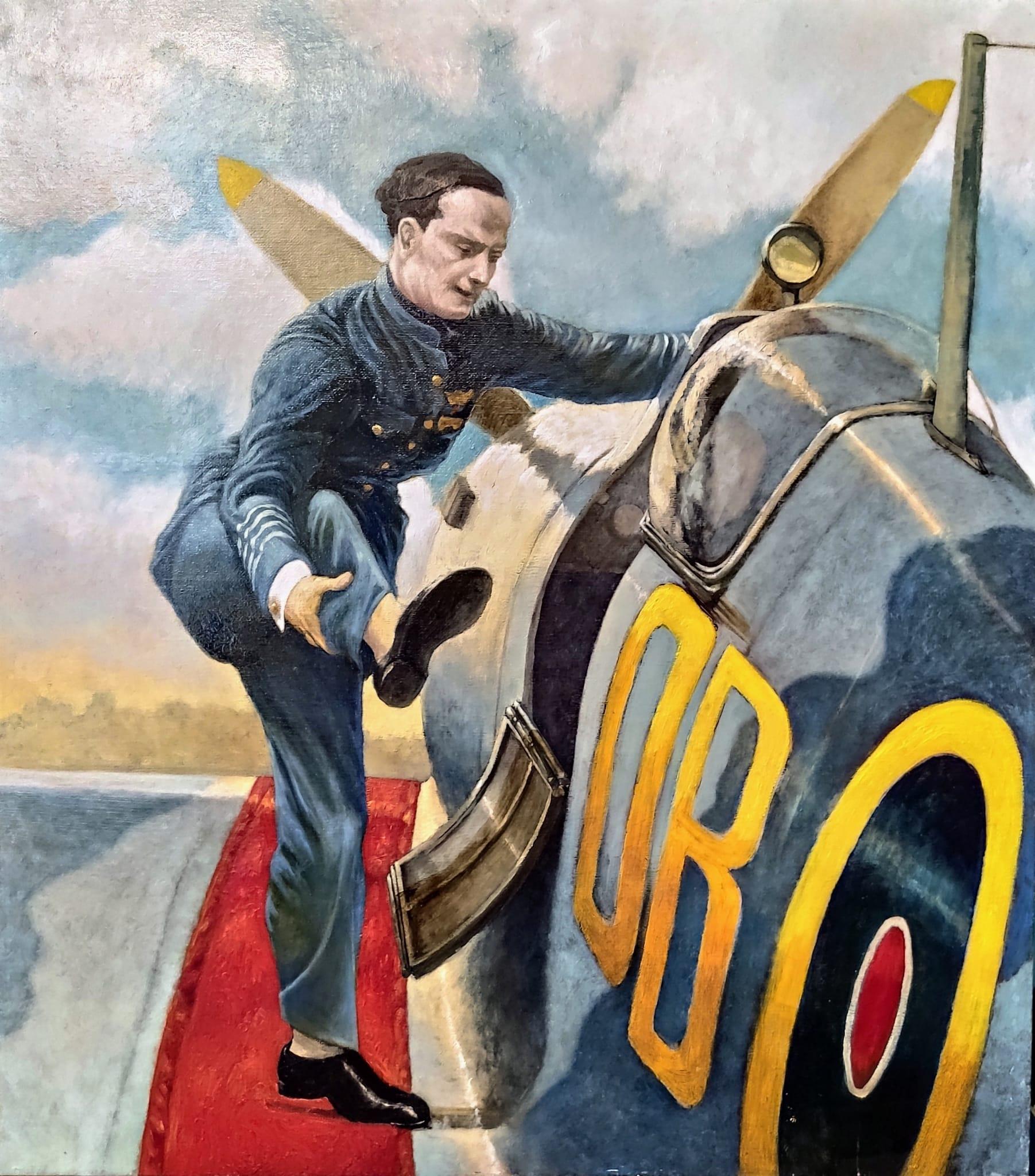
Stefan Nedialkov Popdimitrov – THE PILOT (2013)
Oil on canvas, 120 × 110 cm Original artwork (One of a Kind)
A Moment Before the Sky
In The Pilot, Stefan Nedialkov Popdimitrov captures a suspended moment — the quiet interval that precedes action. The composition presents the legendary Royal Air Force pilot Douglas Bader as he prepares to climb into his aircraft. Yet the painting does not dramatize the event through spectacle or movement. Instead, it isolates a gesture: the physical act of mounting the cockpit. The figure occupies the central axis of the canvas, leaning forward with deliberate control. One leg rises toward the fuselage while the other remains grounded on a strip of red tarmac. The gesture is decisive but measured. It is the posture of a man who has repeated this ritual countless times — a choreography of preparation before confronting the open sky. Rather than depicting aerial heroism, Popdimitrov focuses on the psychological threshold. The pilot is neither airborne nor static; he inhabits the precise instant in which resolve becomes action.Human Figure and Machine
The painting constructs a visual dialogue between the human body and the mechanical presence of the aircraft. The polished surface of the fuselage, rendered in cool metallic tones, curves across the right side of the canvas. Its mass contrasts with the supple anatomy of the pilot’s body. Popdimitrov carefully balances these elements. The aircraft does not overwhelm the figure, nor does the figure dominate the machine. Instead, the two forms interlock through the geometry of the composition: the pilot’s lifted leg echoes the angle of the propeller behind him, while his extended arm stabilizes the transition between body and cockpit. This equilibrium reinforces the central theme of the work. Aviation has always represented a convergence between human courage and technological ingenuity. In The Pilot, that relationship becomes physical. The pilot’s body literally bridges the ground and the aircraft, acting as a hinge between earthbound reality and the possibility of flight.Chromatic Discipline and Structural Clarity
Popdimitrov employs a restrained chromatic palette dominated by deep blues, muted greys, and warm ochres. The pilot’s uniform, painted in dark naval blue, anchors the composition and establishes visual gravity. Against this darker mass, the metallic surface of the aircraft reflects softer tonal variations, suggesting light without excessive sheen. The yellow insignia on the fuselage introduces a sudden chromatic punctuation. These bold letters function both as historical reference and compositional counterweight, drawing the viewer’s gaze toward the aircraft’s body while reinforcing its scale. Behind the figure, the propeller blades and clouded sky generate a sense of spatial openness. Yet the background remains deliberately simplified. Popdimitrov avoids elaborate atmospheric detail, allowing the figure and aircraft to dominate the visual field. This controlled restraint gives the painting an almost poster-like clarity reminiscent of early twentieth-century aviation imagery, while maintaining the material depth of oil painting.Gesture as Narrative
The narrative content of the painting is deceptively minimal. There is no battle scene, no dramatic sky, no visible enemy. Instead, meaning is conveyed through gesture. The pilot’s downward gaze suggests concentration rather than bravado. His hand grips the cockpit rim with familiarity. Even the placement of the foot — carefully aligned with the aircraft’s surface — conveys practical knowledge born from experience. Douglas Bader’s historical legacy is closely associated with resilience and determination. By choosing to depict this understated moment, Popdimitrov avoids heroic exaggeration. The painting becomes less about wartime mythology and more about the human discipline required to confront risk repeatedly. Heroism, here, is quiet. It exists in preparation rather than triumph.Figurative Tradition and Contemporary Sensibility
Popdimitrov’s training at the Academies of Fine Arts in Sofia and Venice is evident in the structural solidity of the figure. The anatomy is carefully modeled, and the volumetric treatment of the body reflects a classical academic grounding in drawing. Yet the painting does not simply reproduce historical realism. The simplified background, the clarity of the composition, and the slightly stylized transitions between tonal planes introduce a contemporary sensibility. The work occupies a space between narrative realism and symbolic figuration. This balance allows the painting to function simultaneously as historical evocation and as visual metaphor. The pilot becomes more than a specific individual; he embodies the broader idea of human aspiration confronting technological frontiers.Surface, Atmosphere, and Monumentality
At 120 × 110 cm, the canvas possesses a scale that reinforces the monumentality of the figure. The pilot’s body appears almost life-sized, granting the viewer an immediate sense of proximity. We do not observe the scene from a distant vantage point; instead, we stand beside the aircraft, sharing the same ground-level perspective. The surface treatment contributes to this immediacy. Brushwork remains controlled but visible, allowing the tactile qualities of oil paint to emerge in areas of shadow and fabric. The sky, softly modulated in pale blues and greys, contrasts with the denser materiality of the figure and machine. This interplay between atmosphere and structure creates a layered visual experience. The aircraft’s curved metal surfaces seem to catch light differently than the textured uniform, while the sky recedes gently behind them. The result is a spatial depth that feels both cinematic and painterly.History as Timeless Image
Although rooted in a specific historical reference, The Pilot ultimately transcends its documentary origins. Popdimitrov transforms the narrative of aviation history into an image that operates symbolically. The act of climbing into the cockpit becomes a metaphor for human ambition — the willingness to enter uncertainty in pursuit of something greater than stability. The painting does not describe the dangers of flight, but its quiet intensity suggests the awareness of them. In this sense, the work reflects a broader artistic tradition in which historical figures become vehicles for universal reflection. The pilot represents courage not through spectacle, but through disciplined resolve.Conclusion
The Pilot stands as a compelling synthesis of figurative precision and narrative restraint. Through careful composition, controlled color, and subtle psychological focus, Stefan Nedialkov Popdimitrov constructs an image that honors both the history of aviation and the human character behind it. Rather than depicting the drama of flight itself, the painting dwells on the moment that makes flight possible. It is the instant when determination takes physical form — when a man places his foot on the aircraft and commits to the sky. In this suspended gesture, Popdimitrov captures something enduring: the quiet resolve that precedes every leap into the unknown.Artwork Data — GAC Archive
Artist: Stefan Nedialkov Popdimitrov
Title: THE PILOT
Year: 2013
Medium: Oil on canvas
Dimensions: 120 × 110 cm
Format: Vertical
Movement: Contemporary Figurative Painting
Genre: Historical figurative painting / Aviation portrait
Description
THE PILOT is a large-scale figurative painting by artist Stefan Nedialkov Popdimitrov. Executed in oil on canvas, the work portrays the legendary Royal Air Force pilot Douglas Bader as he prepares to board his aircraft. The composition focuses on a moment of concentrated determination immediately before flight, transforming a historical reference into a timeless image of human resolve. Through a controlled palette of deep blues, metallic greys, and warm ochres, Popdimitrov constructs a balanced dialogue between the human figure and the mechanical presence of the aircraft. The painting explores themes of courage, discipline, and the enduring relationship between human ambition and technological innovation.
Keywords
Stefan Nedialkov Popdimitrov, THE PILOT, figurative aviation painting, Douglas Bader portrait, oil on canvas, contemporary figurative art, historical aviation art, RAF pilot painting, contemporary realism, GAC Archive