
Franck Brizzi — Train des pignes
The persistence of memory in photographic form
Train des pignes belongs to a clearly identifiable phase in Franck Brizzi’s artistic practice, rooted in analog photography and extended through hand-coloring and digital refinement. The work originates from a silver gelatin photograph and is subsequently transformed through a controlled process of intervention that places it at the intersection of photographic documentation and pictorial interpretation. Rather than functioning as a descriptive record of a historical locomotive, the image operates as a meditation on memory, time, and perception — themes that recur consistently throughout Brizzi’s verified artistic trajectory.
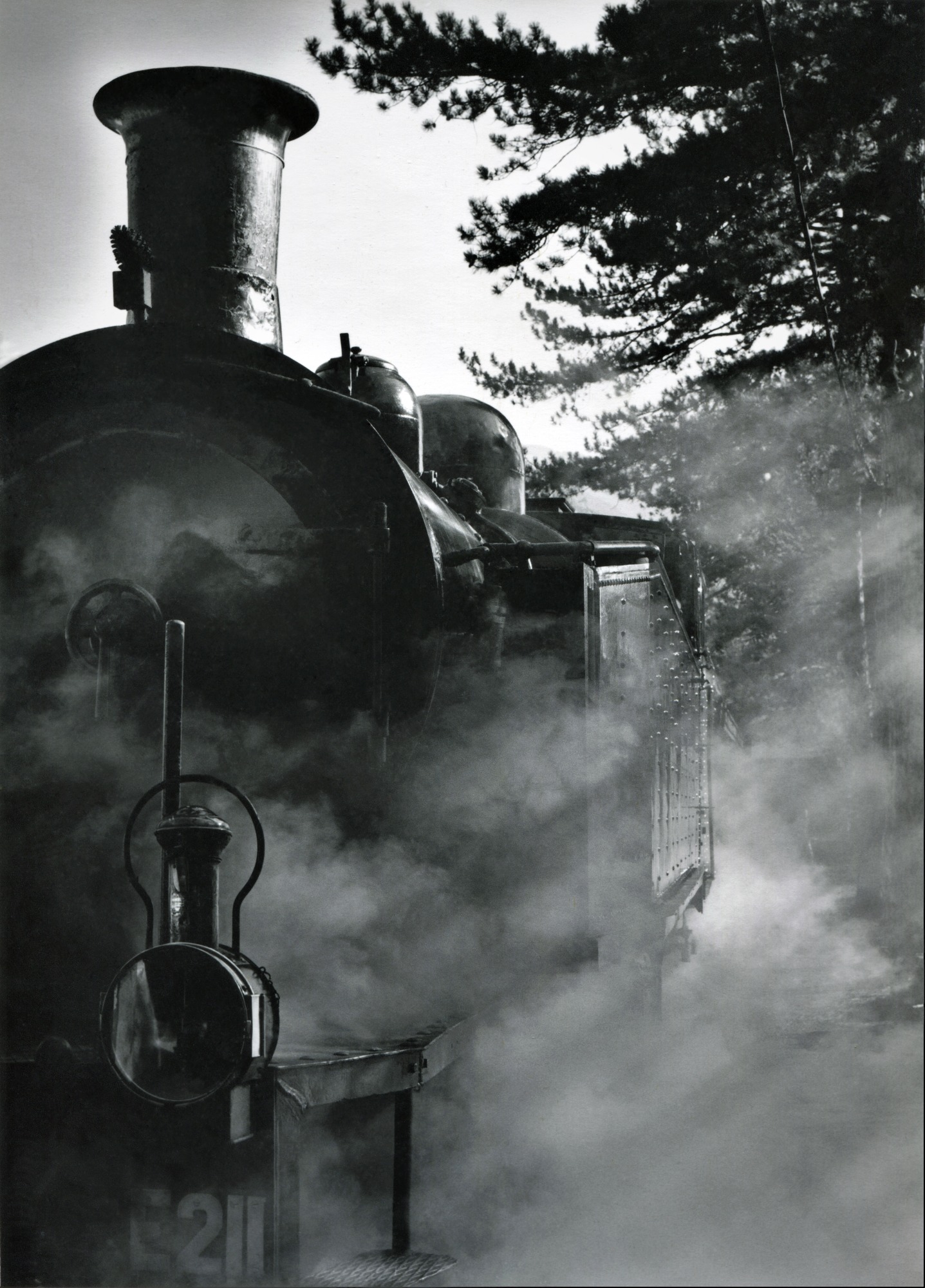
The steam locomotive emerges from a dense, vaporous environment, partially obscured by smoke and framed by vegetation. Its presence is neither frontal nor assertive. Instead, it appears as if recalled rather than observed, evoking the way memory reconstructs events through incomplete forms and softened contours. This visual restraint establishes the work’s conceptual foundation: reality is not denied, but filtered through a temporal and emotional lens.
Analog origin and temporal materiality
The use of analog photography as the basis of Train des pignes carries measurable implications. Analog photographic processes rely on a direct physical interaction between light and photosensitive material, producing an image that is inherently tied to a specific moment in time. This indexical relationship situates the photograph as evidence of an encounter with reality.
Brizzi’s decision to begin with an analog capture reinforces the work’s temporal credibility. The train, the steam, and the surrounding environment are not simulated constructs but elements that existed before the camera. The subsequent transformations do not erase this origin; they operate upon it, preserving the photograph’s status as a factual trace while expanding its interpretive range.
Hand-coloring as interpretive intervention
Following the photographic capture, Brizzi applies hand-coloring, a technique historically associated with early photographic practices. This intervention introduces subjectivity into an otherwise objective medium. The color does not function decoratively; it acts as an analytical layer that repositions the image between past and present.
Historically, hand-coloring was employed to compensate for photography’s initial limitations. In Brizzi’s work, however, the technique is repurposed as a conceptual tool. It allows the artist to question the neutrality of photographic representation and to assert that images, like memories, are continuously reshaped by interpretation. The coloring neither dominates nor conceals the underlying photograph; it engages in dialogue with it.
Digital refinement and controlled synthesis
The final stage of Train des pignes involves digital processing, used not to modernize the image but to stabilize the relationship between its layers. Digital intervention serves a corrective and harmonizing function, ensuring coherence between photographic grain, chromatic modulation, and compositional balance.
This hybrid methodology — analog capture, manual intervention, and digital refinement — results in a work that resists categorical definition. It is neither a traditional photograph nor a conventional painting. Instead, it occupies a verifiable intermediate position, often described as photo-painting, in which each technical phase remains legible within the final image.
Atmosphere and suspended temporality
Visually, Train des pignes is characterized by a dense atmospheric field. Steam occupies a central compositional role, softening spatial depth and diffusing light. This atmospheric condition interrupts linear perspective, causing the locomotive to appear suspended within an indeterminate temporal zone.
The absence of explicit narrative cues — no visible passengers, no destination, no contextual signage — further detaches the scene from chronological specificity. The train becomes an emblem rather than an event, an object that carries historical associations without being confined to a particular moment.
Memory as visual structure
Brizzi’s stated interest in memory finds concrete expression in the structure of Train des pignes. Memory is not illustrated symbolically but embedded formally within the image. The partial visibility of the subject, the tonal compression, and the restrained chromatic range mirror the way recollection operates: selectively, imperfectly, and subject to transformation.
In this sense, the work aligns with established theoretical approaches to memory as a reconstructive process rather than a fixed archive. The photograph functions as a base layer of factual reference, while the painterly interventions simulate the distortions introduced by time and emotion.
Technical discipline and surface integrity
From a technical standpoint, the surface of Train des pignes demonstrates a controlled equilibrium between texture and cohesion. The grain of the analog photograph remains perceptible beneath the layers of color, preserving the tactile quality associated with traditional photographic prints.
The image avoids excessive saturation or dramatic contrast. Instead, it favors tonal continuity and atmospheric depth, reinforcing the work’s contemplative character. Each intervention appears calibrated to slow visual consumption and encourage prolonged observation.
Position within Brizzi’s artistic practice
Train des pignes is consistent with Brizzi’s documented exploration of hybrid imagery developed since the early 2010s, following his rediscovery of historical colorization techniques and his transition from a professional background outside the arts to a fully realized artistic practice.
The work reflects his broader engagement with photographic images that operate between remembrance and imagination, reinforcing a coherent line of inquiry rather than representing an isolated experiment. Its methodology and thematic focus correspond with exhibitions, publications, and public recognitions associated with his career.
Critical interpretation
Critically, Train des pignes can be understood as a reflection on the limits of photographic objectivity. By intervening in the photographic surface without erasing its origin, Brizzi proposes an image that acknowledges both the authority of the photograph and its vulnerability to interpretation.
The work does not seek nostalgia as an aesthetic effect, nor does it romanticize the past. Instead, it examines how technological artifacts — such as trains and photographic processes — persist within cultural memory as mutable symbols. The locomotive becomes a carrier of accumulated meanings rather than a fixed historical reference.
Conclusion
Train des pignes stands as a rigorously constructed work that integrates analog photography, manual intervention, and digital precision into a coherent visual language. Its strength lies in its methodological clarity and conceptual restraint.
By positioning memory as an active process inscribed within the image itself, Franck Brizzi affirms photography’s capacity to move beyond documentation without abandoning its factual foundation. The result is an image that resists immediacy and invites sustained reflection — a measured articulation of time, perception, and the persistence of the invisible within the visible.
Artwork Data — GAC Archive
Artist: Franck Brizzi
Title: Train des pignes
Year: not specified
Medium: Analog photography (silver gelatin print), hand-coloring and digital refinement
Dimensions: not specified
Format: Rectangular
Movement: Contemporary Photography / Photo-Painting
Genre: Landscape / Memory-based imagery
Description
Train des pignes is a contemporary photographic work by Franck Brizzi, originating from an analog silver gelatin photograph and later transformed through hand-coloring and digital refinement. The image depicts a historic steam locomotive partially obscured by vapor, emphasizing atmosphere and temporal suspension rather than documentary detail.
The work explores the relationship between photography and memory, positioning the image between factual record and interpretive transformation. Through controlled intervention, Brizzi redefines the photograph as a hybrid object situated between photography and painting.
Keywords
Franck Brizzi, Train des pignes, contemporary photography, analog photography, silver gelatin print, hand-colored photography, photo painting, memory and perception, GAC Archive