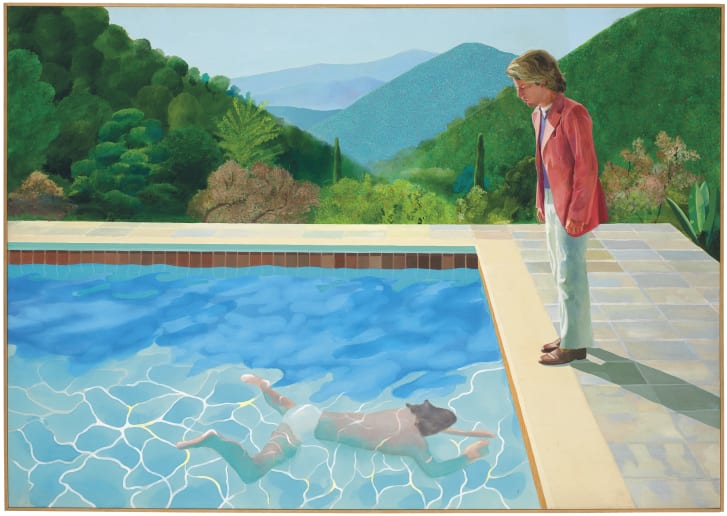
David Hockney’s “Portrait of an Artist (Pool with Two Figures)” (1972) stands as one of the most iconic works of contemporary art, merging Hockney’s fascination with water, light, and the complexities of human relationships. As a pivotal figure in 20th-century figurative painting, Hockney’s exploration of realism and abstraction finds a harmonious balance in this composition. The painting not only exemplifies his technical mastery but also evokes deep emotional undertones that invite the viewer into a narrative marked by tension, reflection, and the subtle play between presence and absence.
Pictorial Style and Composition
The painting is dominated by two figures, positioned in a dramatic spatial relationship. One, fully clothed, stands on the edge of the pool, gazing down at the second figure who is submerged in the water, swimming towards the edge. This simple yet charged arrangement sets the tone for a deeper psychological exploration. Hockney’s mastery of compositionis evident in the way he arranges the scene to guide the viewer’s eye naturally from the standing figure to the swimmer and then through the backdrop of verdant hills and distant mountains.
The use of perspective is another notable element in the painting. The angular lines of the pool’s edge and the parallel placement of the two figures create a sense of depth, while the mountainous background stretches out into the distance, offering a sense of openness and escape. The positioning of the swimmer in a horizontal plane contrasts with the upright posture of the standing figure, reinforcing the dichotomy between the two. The formal arrangement of the painting is deceptively simple, but its visual geometry adds tension to the scene, as if the two figures exist in parallel but separate realities.
Use of Color and Light
Hockney’s use of color in this painting is characteristic of his style: bold, bright, and saturated. The blue of the pool water, painted with exquisite care, dominates the foreground. The shimmering surface is rendered with meticulous attention to the play of light and reflection, capturing the distortions caused by the ripples and waves. Hockney’s skill in representing water has long been a hallmark of his work, and in “Portrait of an Artist”, the pool becomes a key focal point—not just a physical space, but a metaphor for emotional depth and fluidity.
The clothing of the standing figure—rumored to be a representation of Peter Schlesinger, Hockney’s lover at the time—stands out in a muted red jacket against the lush greenery of the background. This color contrast serves to heighten the emotional weight of the figure, positioning him as a dominant presence, but also one marked by contemplation and perhaps uncertainty. The swimmer, on the other hand, is dressed in white, blending with the cool blues of the water, suggesting a sense of purity or detachment.
The background landscape, though meticulously painted, serves as a soft counterpoint to the drama unfolding in the foreground. The varying shades of green, from the trees to the mountains, offer a sense of tranquility, yet the slight haze in the distance hints at an emotional fog, as if the relationship between the two figures is marked by an unresolved tension. The light, diffused and soft, gives the entire scene an ethereal quality, bathing the landscape and figures in an even, yet subtly shifting, illumination.
Brushwork and Technique
Hockney’s brushwork in this painting is clean, deliberate, and precise, reinforcing the realism of the scene while also lending it a sense of stylization. The surface of the water, painted with a fine, almost linear pattern, contrasts with the looser brushstrokes used in the background trees and foliage. This contrast between the tight, controlled strokes of the water and the freer, more expressive handling of the landscape draws attention to the dualities within the painting: clarity and ambiguity, connection and separation, realism and abstraction.
Hockney’s use of photographic references is also apparent in the meticulous details of the figures and their surroundings. The painting is based on two separate photographs—one of a man swimming and another of a man standing by a pool—combined to create a cohesive narrative. The result is a composition that feels both staged and spontaneous, a snapshot of a moment frozen in time, yet imbued with an underlying emotional charge.
Themes and Symbolism
At its core, “Portrait of an Artist (Pool with Two Figures)” is a study in human relationships—particularly the tension between intimacy and distance. The physical space between the two figures mirrors the emotional distance between them. The standing figure’s pensive gaze toward the swimmer can be interpreted as one of longing, contemplation, or even resignation, while the swimmer, focused on his own motion, seems unaware or indifferent to the presence of the other.
The pool itself, a recurring motif in Hockney’s work, becomes a symbol of emotional depth, separation, and reflection. The water, with its ability to distort and refract, suggests the fluidity of emotions and the complexity of human connection. The swimmer’s submerged figure can be seen as both physically distant and emotionally inaccessible, while the standing figure, though closer to the viewer, remains enigmatic, his thoughts and feelings obscured.
Hockney’s personal life and his relationship with Peter Schlesinger add another layer of meaning to the painting. Created during the aftermath of their breakup, the painting can be read as a meditation on loss, distance, and the difficulty of reconciling emotional closeness with personal independence. The tension between the two figures reflects the complex dynamics of relationships—whether romantic or otherwise—and the sense of isolation that can exist even within intimate connections.
The Broader Context of Hockney’s Work
“Portrait of an Artist (Pool with Two Figures)” is part of Hockney’s larger body of work from the late 1960s and early 1970s, during which he became fascinated with the depiction of pools, water, and sunlight, particularly in the context of California’s modern, suburban landscapes. These works often explore themes of leisure, desire, and the passage of time, filtered through Hockney’s unique perspective as a British expatriate in America.
Hockney’s work from this period is characterized by its meticulous attention to detail, its vibrant use of color, and its exploration of psychological depth within seemingly mundane scenes. The California pools, in particular, became a symbol for Hockney of the pleasures and complexities of modern life—spaces of both physical freedom and emotional complexity. In this sense, “Portrait of an Artist” can be seen as a culmination of Hockney’s experiments with the pool motif, but also as a deeply personal reflection on his own emotional experiences.
Conclusion: A Masterpiece of Emotional Subtlety and Technical Precision
David Hockney’s “Portrait of an Artist (Pool with Two Figures)” is a masterclass in the use of composition, color, and light to convey complex emotional narratives. The painting’s striking balance between realism and abstraction, between the serene and the tense, creates a powerful visual dialogue that invites the viewer to contemplate not only the relationship between the two figures but also the broader themes of connection, isolation, and the passage of time.
Hockney’s ability to transform a simple scene—a man standing by a pool, watching another swim—into a rich, layered narrative is a testament to his skill as both a painter and a storyteller. The painting’s quiet beauty, its subtle emotional tension, and its meticulous execution make it one of Hockney’s most celebrated works, resonating deeply with viewers both for its technical brilliance and its poignant exploration of human relationships.
In “Portrait of an Artist”, Hockney captures a fleeting moment that feels both intimate and distant, inviting us to step into the scene and reflect on our own experiences of love, loss, and the complexity of human connection. It is a painting that lingers in the mind, much like the unresolved emotions it so delicately portrays.